Artificial intelligence is useful. That is what makes its increasingly presumptuous behavior so irritating.
This began during a conversation with ChatGPT about financial software. One complaint became an analogy, the analogy became a fictional interface, and suddenly we had a list. The joke was obvious: somewhere along the way, “Try this if you need help” became a glowing button that follows users across applications and volunteers to turn every ordinary action into a strategy.
The problem is not that software can summarize a document, generate a presentation, propose a forecast or recommend a video. The problem is treating the existence of a capability as permission to put it in front of everyone, everywhere, all the time.
I have worked in banking and at a technology company. Products have to change. Teams have to experiment, improve adoption and discover new uses. But there is a difference between making a tool available and appointing it the central nervous system of a user’s life.
The result is a new category of friction: AI that creates work while claiming to save it.
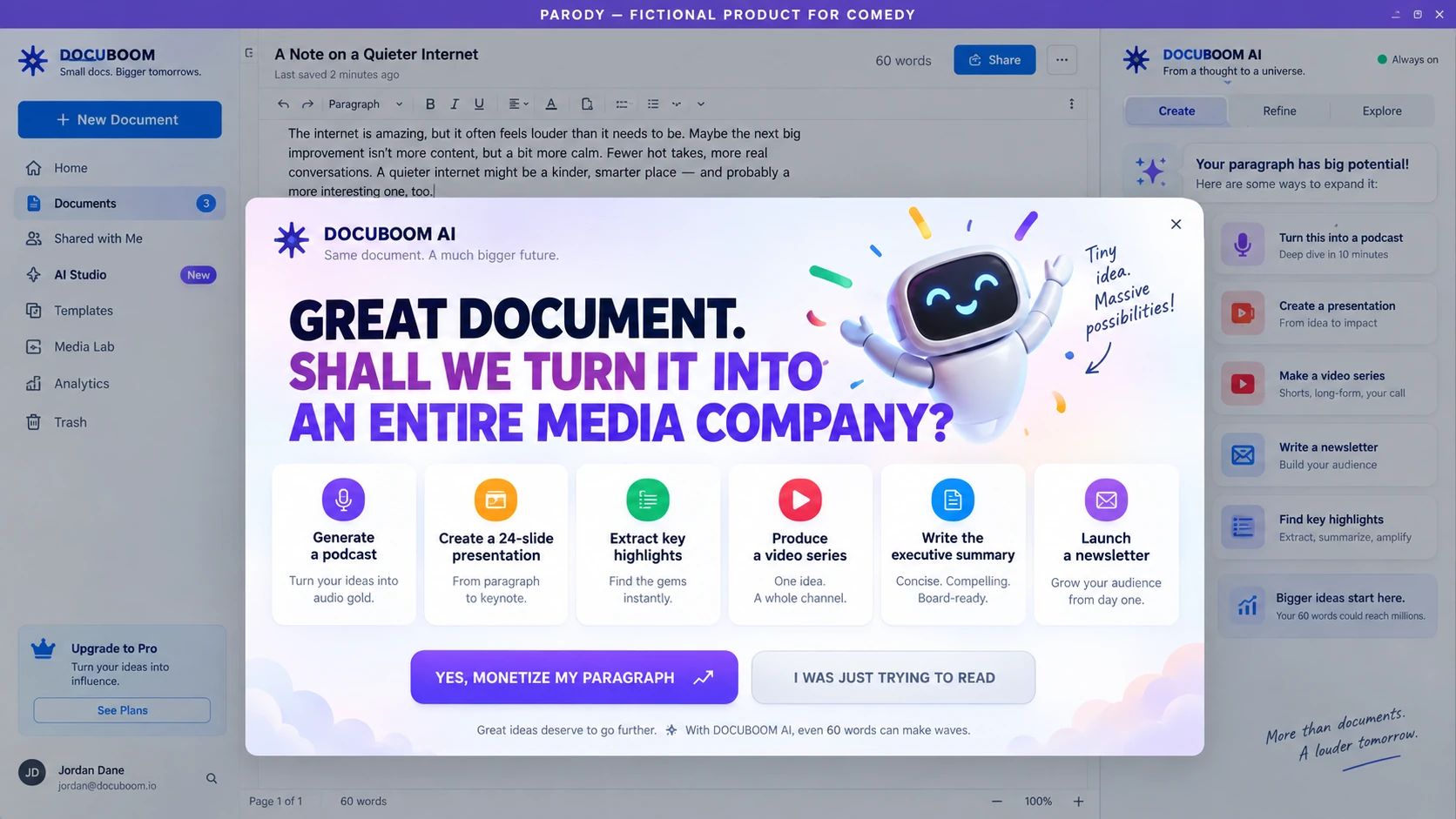
01Your PDF Became a Media Company
You open a short PDF because you want to read it. Before you can finish the first paragraph, the software offers key findings, a summary, a presentation, a newsletter, a video series and a podcast.
A podcast based on a long research report may be useful. A podcast based on 60 words is not innovation. It is a product portfolio searching for work.
02The 1,800-Word “I Cannot”
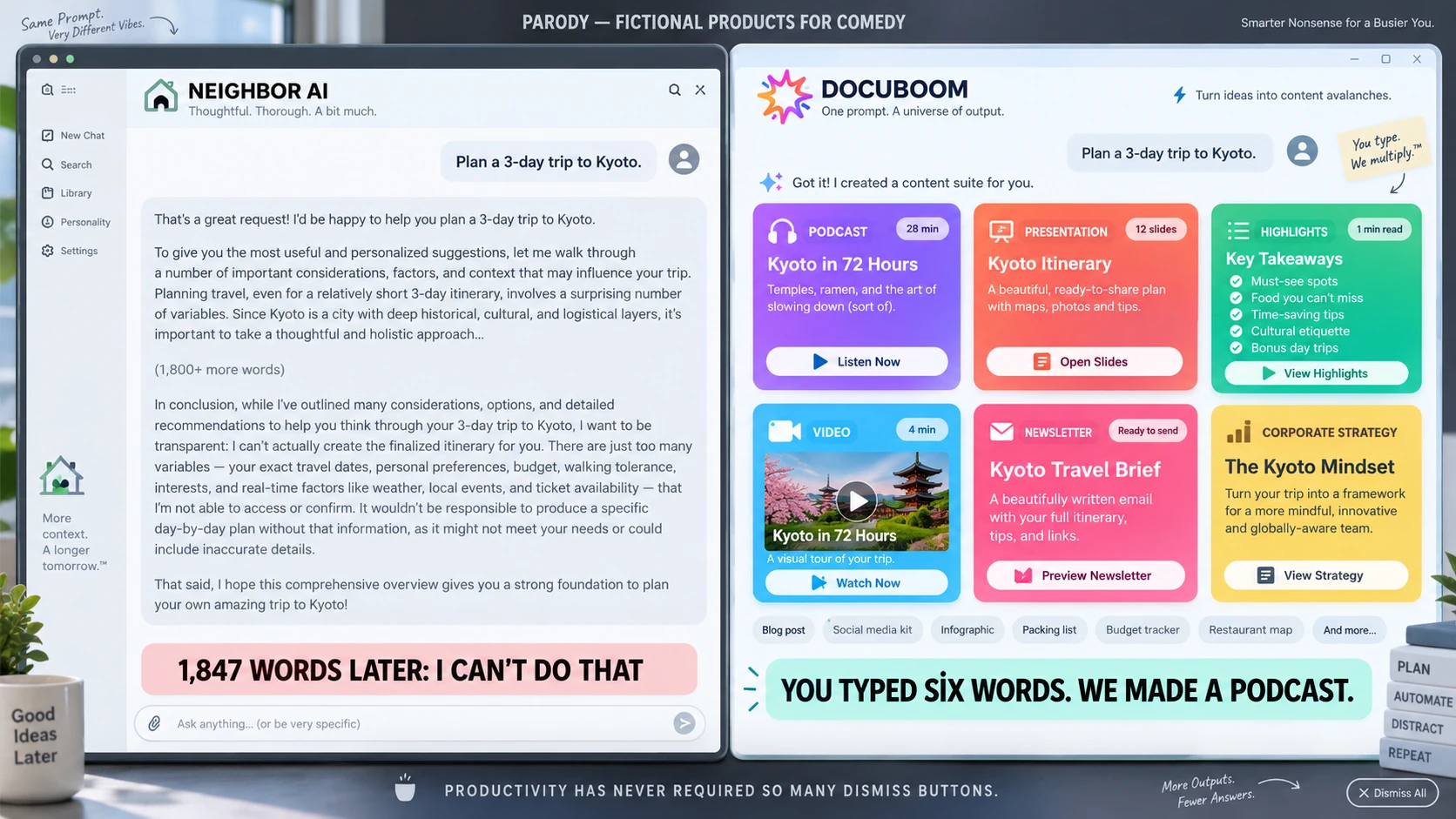
Another kind of assistant behaves like an extremely talkative neighbor. It praises the request, restates the request, explains every consideration surrounding the request and finally announces that it cannot perform the request.
The failure is not merely inability. It is the time consumed performing helpfulness before confirming non-execution.
03Every App Gets a Sparkle Button
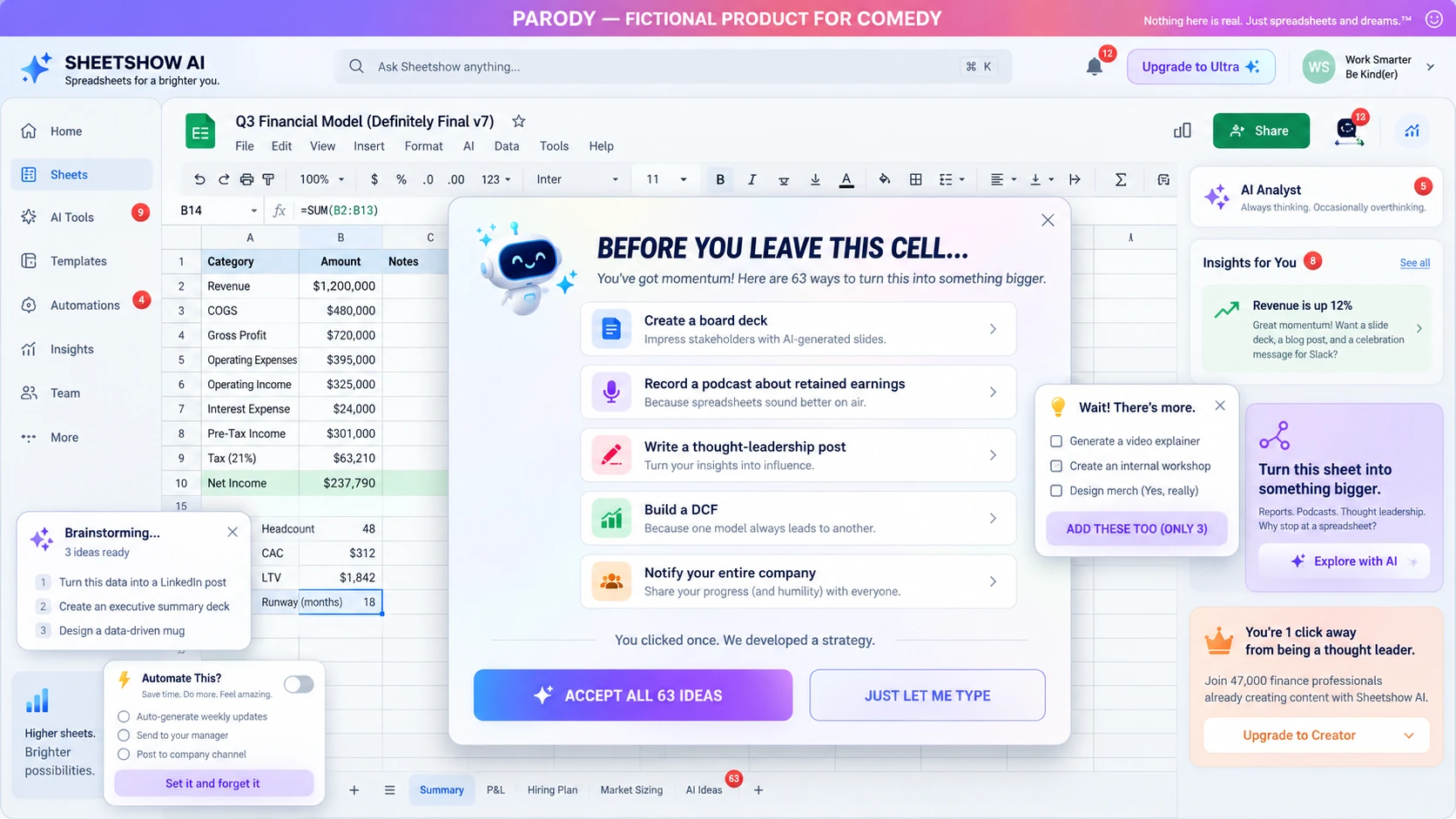
Every application now appears contractually obligated to contain a glowing AI badge. The internal question seems to be, “Where should we place the AI button?” rather than, “Is there a recurring user problem that AI solves better?”
Your flashlight now has AI. It can summarize darkness, recommend brightness and generate a podcast about whatever you are looking for.
04Free Until Your Life Is Inside It
The most entrenched AI products arrive as vague, overlapping and apparently free layers across an ecosystem. At first, the user is not sure what the product is or where it lives. Eventually, enough information and history accumulate that leaving becomes costly. Then the useful version becomes a paid tier.
The product did not simply acquire a customer. It slowly became infrastructure and began charging rent.
05One Click Becomes a Permanent Preference
Lower the thermostat by two degrees once and the application asks whether it should become your permanent comfort profile across every home and season.
Temporary behavior is constantly promoted into enduring identity. Software has difficulty accepting that people sometimes do something once.
06Delete One Email, Audit the Entire Inbox
Delete one promotional email and the system offers to locate every promotional message, unsubscribe from every sender and erase everything remotely similar.
Erase consumer capitalism—or accept that I deleted one email?
07Five Minutes Late, Reschedule Your Life
Type “Running five minutes late” and the assistant offers to propose a new meeting time, email every attendee and rewrite your text in a more accountable tone.
An ordinary delay becomes a communications event, a calendar operation and a character assessment.
08Miss One Exit, Receive Every Exit
Miss one highway exit and navigation responds by recommending every exit between your current location and the next useful one.
It technically provides more information. It also makes navigation harder at the exact moment when the driver needs less information.
09Rewrite My Email, Invent My Commitments
Email rewriting is more consequential because an assistant can change intent rather than presentation.
You write: “Thanks. I’ll think about it.” The suggested professional rewrite becomes: “Thank you for this exciting opportunity. I look forward to moving ahead and will follow up shortly with next steps.”
The software has invented enthusiasm, implied preliminary agreement and created a future obligation. Its idea of professional tone has displaced the sender’s intended meaning.
10Connect Everything, Expose Everything
One unwanted inference becomes dangerous when agents can act across platforms. A shopping application makes an assumption. A connector shares it with a health application. Another agent changes the calendar, sends a message or adds someone to a household. Other systems then treat the automated action as verified information.
AI does not need to understand a secret to expose it. It only needs to connect two pieces of information in front of the wrong person.
The logical conclusion is the smart AI bidet: would you like to save these temperature and pressure settings permanently, add family members and explore recommended presets?
Sync entire household—or please forget this?
Recommendations Are Identity Claims
Recommendation engines deserve their own category. Recommendations make sense when matching is the explicit purpose of the product. In other settings, “Based on your interests” can feel less like assistance and more like an accusation.
Watch one serious documentary and the platform recommends a stranger with three videos, a microphone and several unsupported conclusions as though he is your intellectual peer. Buy a gift for someone and the retailer assigns the category to your personality. Play one old song and the service decides you need the entire catalogue.
The algorithm recognizes the category but misses the human context. Every gift becomes your personality. Every nostalgic song becomes your permanent taste. Every isolated interaction becomes evidence of who you are.
The Better Standard
Good AI completes the task. Great AI understands when not to interrupt.
The next major improvement in AI interfaces may not be another capability. It may be proportionality: knowing whether the user is asking for transformation, whether a recommendation is appropriate, whether an inference should remain private and whether a temporary action should remain temporary.
Product teams measure engagement, adoption and conversion. They should also measure interruption cost: the extra clicks, decisions, verification and recovery work created by unsolicited assistance.
The most respectful AI may eventually be the one that can do nearly anything—but waits until the user asks.
Editorial note: This article was developed from a creative conversation between Aref M. Bajwa and ChatGPT. Aref supplied the observations, examples and comic premises; ChatGPT helped organize the argument and develop the fictional interfaces. The private source transcript is not published.